Hello!
I am an astronomer at the University of Edinburgh. My main interests are to find out how, when and why galaxies stop forming stars, i.e. quench.
Stars are formed from the collapsing of cold gas. All galaxies start off as a star-forming galaxy. But as the galaxy evolves, many physical processes, some internal and some external, can either cut off the gas supply, lower the gas to star conversion efficiency, or even eject the gas from star-forming regions.
Because a galaxy is made up of stars of different ages, it carries imprints of the past about its history of star formation, and the conditions at that time. By studying these imprints, we can wind back the clock and piece together how the galaxy formed and quenched.
My research focuses on leveraging statistical techniques to reveal the star-formation and chemical abundance histories of quenched galaxies. This journey have led to studies ranging from close by rapidly quenching galaxies, to some of the earliest massive quiescent galaxies found just 2 billion years after the Big Bang.
Recent Work
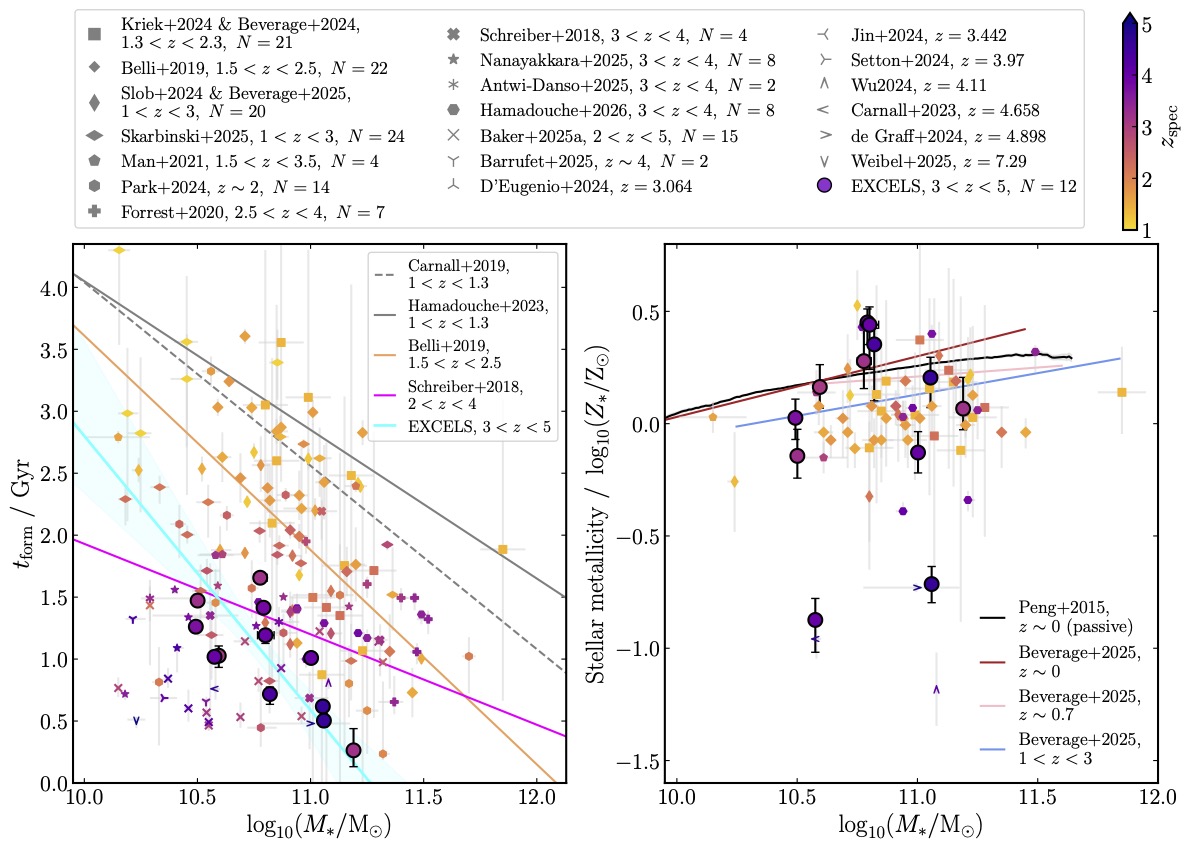
The stellar ages and abundances of the earliest 3<z<5 massive quiescent galaxies from JWST (2026)
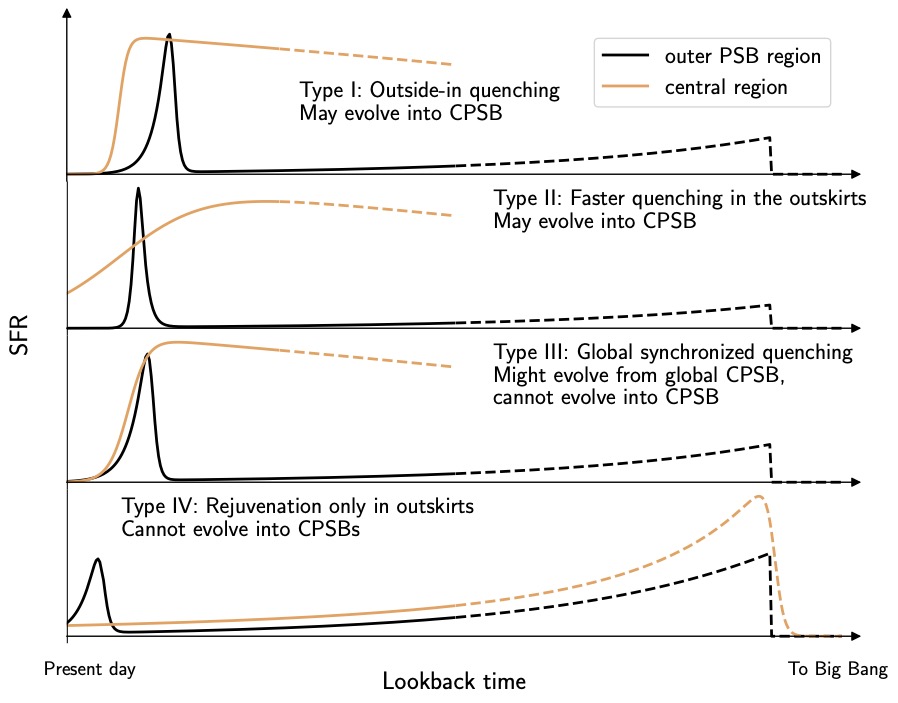
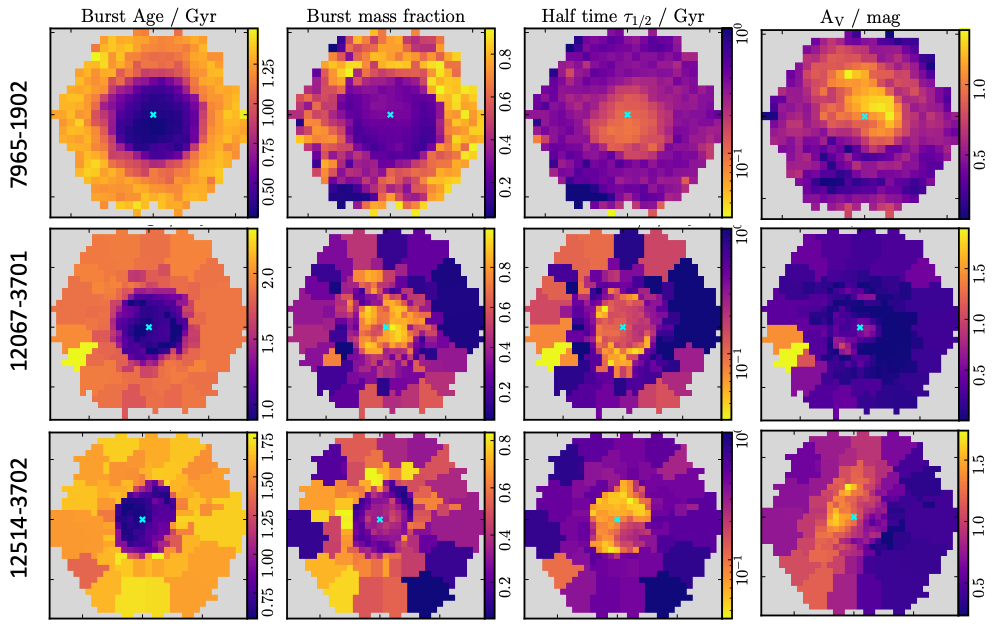
Did all local post-starburst galaxies quench through the same pathway? (2025)
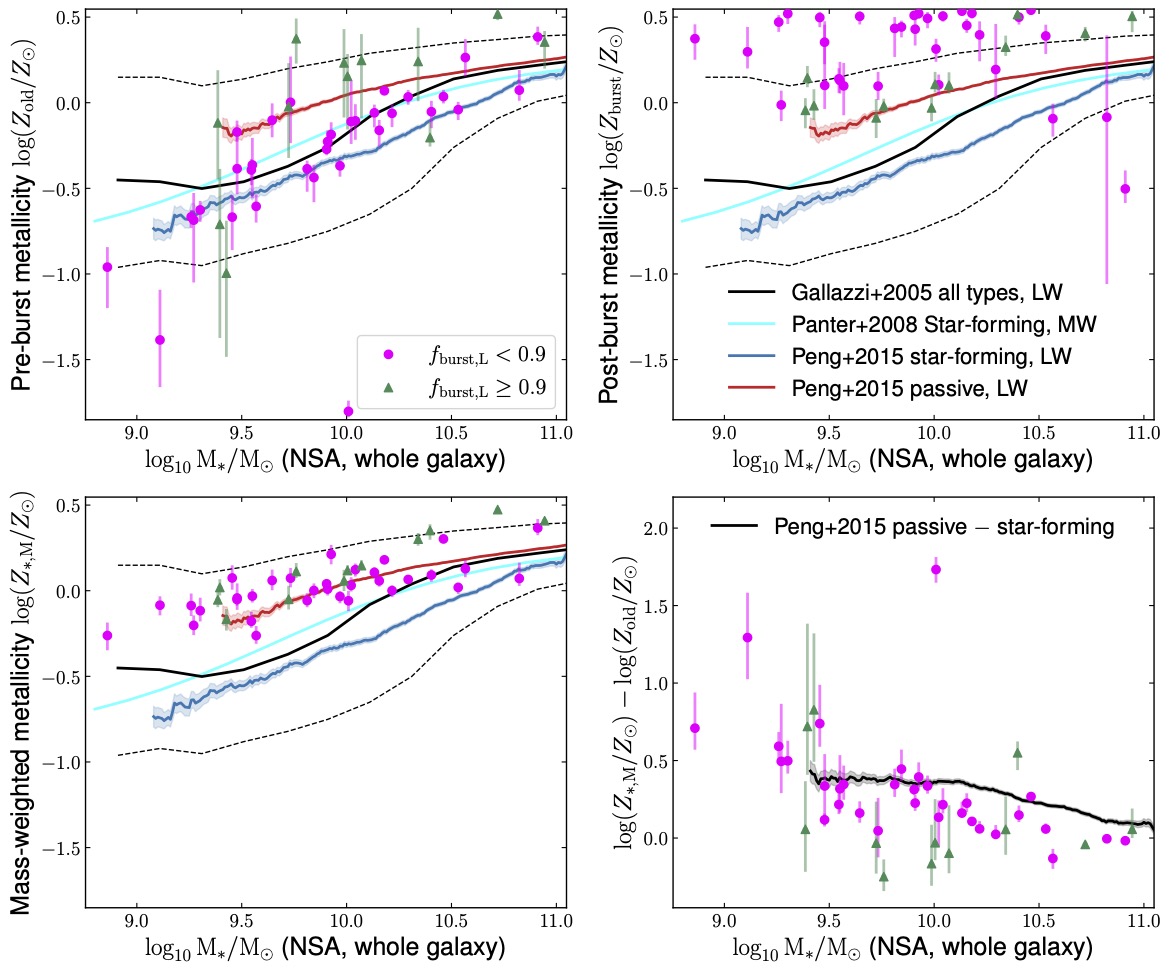
How does stellar metallicity evolve during starburst and rapid quenching? (2024)
Talks and conferences
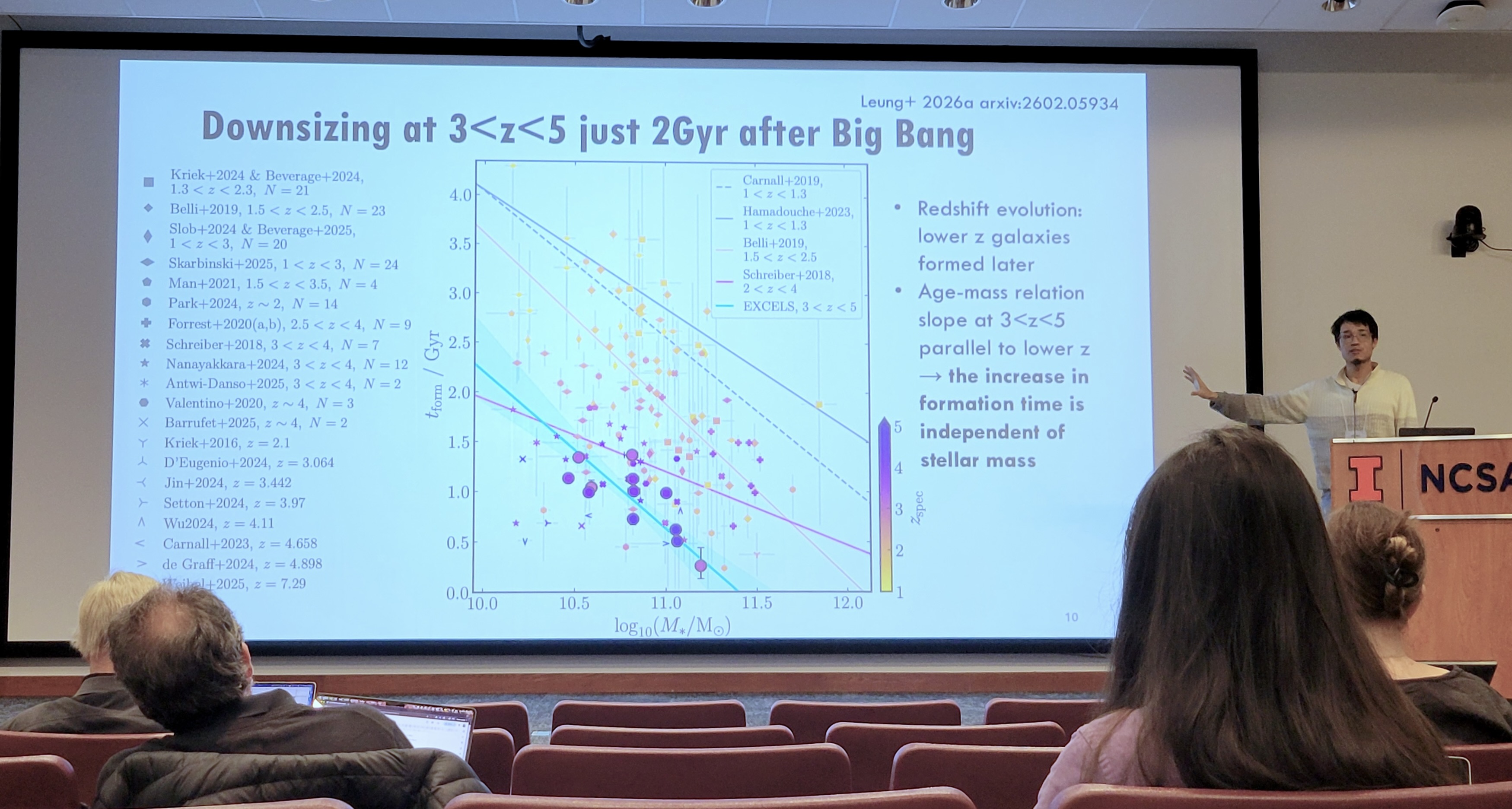 Invited talk @ "End of Star Formation" conference, University of Illinois. Credit: Guillaume Hewitt
| 2026 | |
| 10 April | Universidade Federal de Santa Catarina, Brazil, online Colloquium |
| 23 March | Lancaster University, Seminar to the Observational Astrophysics Group |
| 06 March | Invited talk @ "End of Star Formation" conference, University of Illinois |
| 2025 | |
| 10 December | University of Lancashire, Jeremiah Horrocks Institute seminar |
| 30 September | University of St Andrews, Astronomy lunch seminar |
| 25 September | University of Victoria, online talk |
| 28 May | Flash talk @ "CFC Inaugral Conference", The University of Texas at Austin |
| 04 April | Princeton University, online "galread" seminar |
| 09 January | contributed talk @ "DEX XXI", Newcastle University |
| 2023 | |
| 12 December | contributed talk @ "Resolving Galaxy Ecosystems Across All Scales” conference, The Chinese University of Hong Kong |
| 13 November | University of Edinburgh, coffee talk |
| 04 October | contributed talk @ "A Life Devoted to Stellar Populations" conference, Puerto de la Cruz, Tenerife |
| 10 January | contributed talk @ "DEX XIX", University of Edinburgh |
| 2022 | |
| 05 September | short talk @ "Epoch of Galaxy Quenching” conference, University of Cambridge |
Useful tools
Here is a list of tools that I made or helped make. They might be useful for your projects.
pipes-vis
A small, interactive GUI/visualizer tool for galaxy stellar population model spectra, powered by Adam Carnall's Bayesian Analysis of Galaxies for Physical Inference and Parameter EStimation (BAGPIPES). After setting up some model galaxy, you can use the sliders to adjust the physical properties and see how it affects the spectrum, and other observables e.g. spectral indices. It might also be useful for teaching.
Wavelength-varying 1D spectral extraction
JWST NIRSpec slit spectroscopy suffers from undersampling of the spatial point spread function. Combined with the slightly misaligned footprint of the slit on the detector with the detector's grid, "wiggles" on the 5% level can appear in the 1D spectrum if traditional optimal extraction is performed. This is most commonly seen in medium and high resolution spectra. This tiny python script impliments a wavelength-varying optimal extraction approach, which lowers the amplitude of the "wiggles" to ~1% level.
Other links
I like exploring the Scottish countryside and I like taking pictures. Some of those pictures are not terrible.
Some pictures
Walkhighlands Munro map