
How does stellar metallicity evolve during starburst and rapid quenching? (2024)
The metallicity (amount of elements heavier than Helium relative to the amount of Hydrogen) in a galaxy is mainly determined by three things: inflow of metal-poor gas dilutes the existing gas reservoir and drops metallicity, star formation increases metallicity by returning metals produced inside them to their surroundings when they die, and outflows originating near stars can remove metals to lower metallicity.
So by tracing how the metallicity evolved in galaxies, we can use this to understand its past episodes of fueling and star formation. Stars at different ages reflect the metallicity of the gas it formed from, thus keeping a record of the galaxy's past chemical condition. If we measure the stellar metallicity's past evolution, we can peer into the galaxy's past.
It is extra interesting to perform this measurement on rapidly changing galaxies, such as post-starburst galaxies. These are galaxies that have recently went through a starburst followed by rapid quenching. The measuring of their past metallicity evolution can provide hints for what could have fuelled the starburst and triggered the rapid quenching.
An extra piece of motivation for this work is that in the past, studies of large galaxy samples in the SDSS found the so-called mass-metallicity relation, where galaxies with higher mass are generally more metal rich in their stars. However, when they split the sample into star-forming and quenched galaxies, they found the relations do not overlap. Quenched galaxies are consistently more metal-rich than star-forming galaxies of the same mass (Peng et al. 2015, Trussler et al. 2020). They use this to conclude that at z~0, galaxy quenching is dominated by slow-quenching processes, because rapid quenching will not allow enough time for quenching galaxies to build up enough metals and leave the star-forming mass-metallicity relation (see figure). We set out to test this by measuring the metallicity evolution of galaxies that have rapidly quenched by selection.
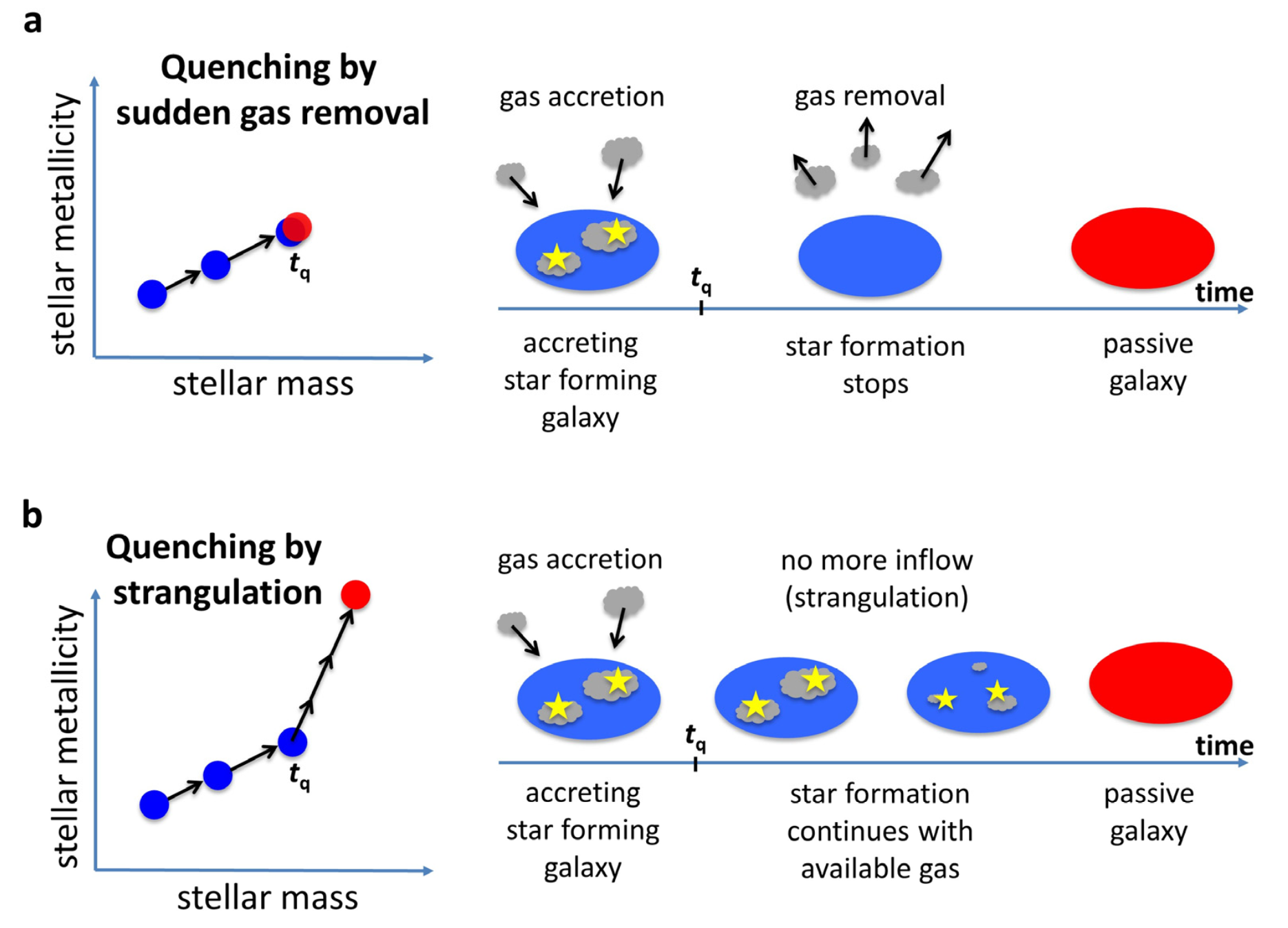 Figure 1 from Peng et al. (2015), aruging how only slow quenching (strangulation) can explain the large gap between the star-forming and quenched stellar mass-metallicity relations seen in z~0 galaxies.
In this work we measured the star-formation histories together with both the pre-burst and post-burst stellar metallicities of 48 MaNGA post-starburst galaxies. We found most of them to form significantly more metal-rich stars during and after the starburst. When the measured metallicities are placed on top of mass-metallicity relations in the literature (see below), the pre-burst metallicity lines up well with the star-forming relation. The overall mass-weighted metallicity (as if the galaxy was measured with a single metallicity across time) lines up well with the quenched mass-metallicity relation. This suggests that the starburst and rapid quenching in post-starburst galaxies is enough to explain the gap between the two mass-metallicity relations. Therefore, slow-quenching need not be the dominant quenching pathway at z~0.